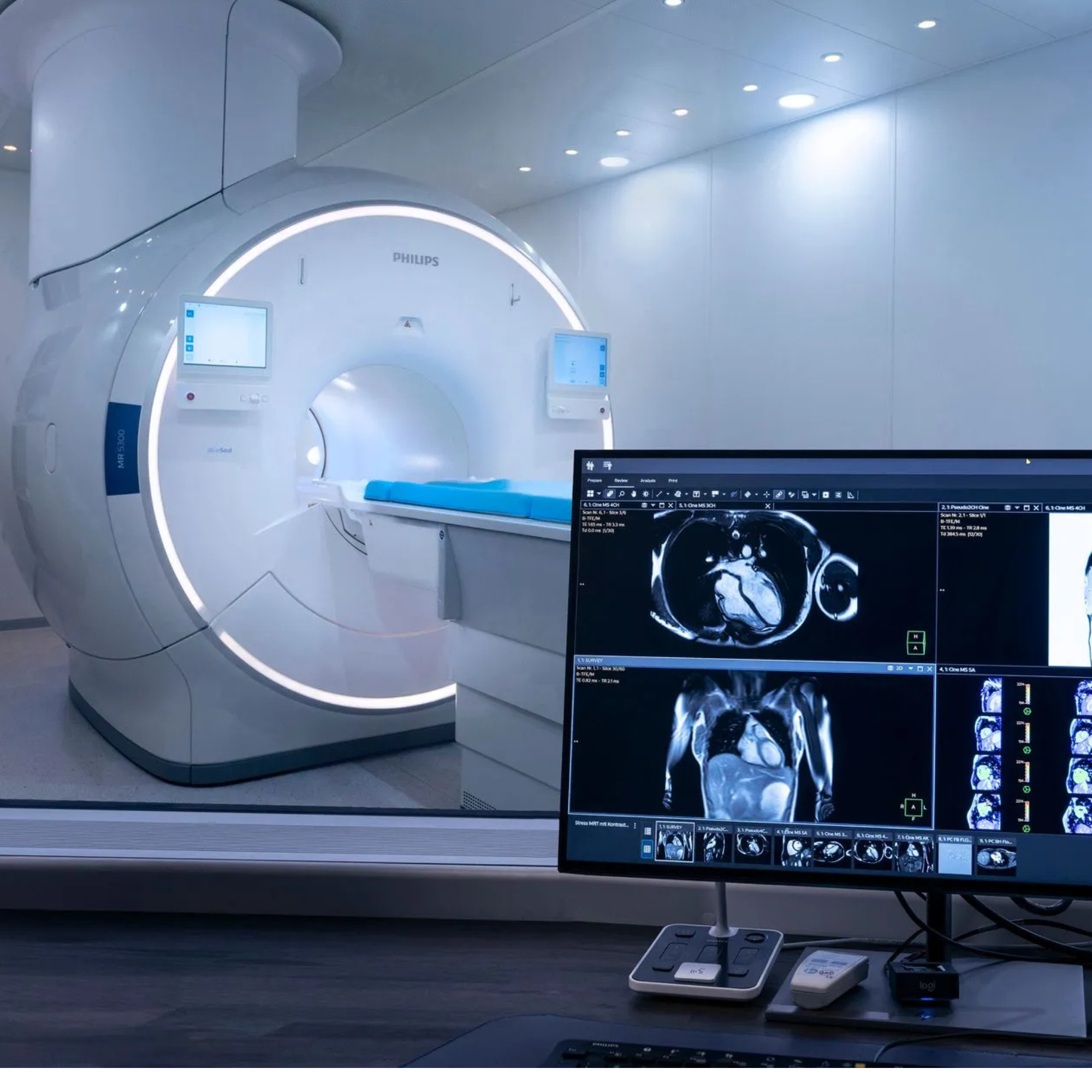
Cardiac MRI – Cardiovascular diagnostics as a milestone in modern prevention
At Buff Medical Resort, we view cardiovascular prevention as a step-by-step, individualized process. It begins with a thorough diagnostic assessment, which includes cardiac MRI and AI-assisted analysis. Together, we will use these insights to determine the most effective measures for your heart health.
Changes to the heart and blood vessels often develop silently over many years—long before symptoms like chest tightness, shortness of breath, or a noticeable drop in performance become apparent. High blood pressure, undetected inflammation, lipid metabolism disorders, or chronic daily stress often take a gradual toll on the heart muscle.
A cardiac MRI provides a radiation-free, high-precision look at the heart. It reveals early vascular strain, tiny blood flow disturbances in the smallest vessels, or the onset of tissue remodeling that would remain hidden during a standard ultrasound. By combining these results with your personal risk profile, stress tests, and targeted lab values, we create a reliable foundation to protect your heart early and effectively.

Prioritize cardiovascular health early on
Heart health means much more than just the absence of an acute heart attack. It is reflected in the adaptability of the entire cardiovascular system: How elastic is the heart muscle? How well does blood flow through the fine vessels? And how harmoniously do tension and relaxation work together?
If heart disease runs in your family, it is a good reason for a timely check-up—but by no means an inevitable fate. Genes are usually just the starting point, not the final outcome. In modern prevention, we therefore ask specifically: What does your heart need today to fully maintain its resilience and performance well into old age?
What does a cardiac MRI show?
Magnetic resonance imaging creates detailed cross-sectional images without any X-ray radiation. It reveals functional and structural details that cannot be seen from the outside, nor via an EKG or echocardiogram:
- MyoStrain analysis (cardiac muscle micro-motion): Conventional values, such as ejection fraction, often remain deceptively normal for a long time. MyoStrain analysis instead measures the tiniest deformations of individual muscle fibers. It serves as a highly sensitive early warning system for minor blood flow restrictions or strain.
- Vascular function without stressful medications: Using gentle techniques (such as short breathing maneuvers or defined hyperventilation phases), we test the natural dilation of the vessels physiologically—without the need to inject artificial stress-inducing drugs.
- Detection of silent scars and lesions: Special sequences precisely track down even tiny scars resulting from unnoticed inflammation or minor circulatory disturbances.
- Precise measurement: Cardiac MRI is considered the global gold standard for measuring heart muscle mass, wall thickness, and pump volume with millimeter precision.

Detect early changes – take action in time
The great advantage of a cardiac MRI: We can detect changes at a stage when you still feel fit and healthy.
Women are disproportionately affected by functional circulatory disorders of the heart, where the major coronary arteries appear completely normal, but the symptoms originate in the smallest vessels. In cardiology, this condition is known as coronary microvascular dysfunction (CMD) or INOCA (Ischemia with Non-Obstructive Coronary Arteries).
If the smallest vessels are strained by stress, blood pressure, or metabolism, the heart gradually loses its elasticity. If this is detected in time, the process can be stopped or even reversed in the vast majority of cases. An MRI does not provide a rigid verdict; instead, it shows the current state of your heart—providing the perfect leverage for your health.
Cardiac MRI is considered the most precise, non-invasive method for making these changes, which are often overlooked for years, visible.

Practical implications for your heart health
A cardiac MRI provides both you and us with a crystal-clear baseline. If subtle imbalances appear, we can take proactive steps early on—whether through lifestyle changes, training adjustments, or targeted metabolic support. It is not about over-diagnosis, but about the long-term vitality of your heart.
From MRI scan to personalized prevention plan
We develop your tailored prevention plan based on your MRI results. Imaging is never viewed in isolation, but rather integrated into a holistic assessment:
· Personal risk factors: Family history, genetics, and daily work-related stress
· In-depth metabolic diagnostics: Advanced lipid profile, inflammation, and metabolic markers
· Innovative early detection: Specialized diagnostics, partly AI-supported, for analyzing functional vascular stress
This is how we turn state-of-the-art high-performance diagnostics into a tangible, effective strategy for your long-term health.
Conclusion
A cardiac MRI provides an unparalleled, non-invasive look into the heart muscle and blood vessels. Thanks to advanced functional measurements like MyoStrain and the use of our own breathing as a natural contrast agent (oxygen), we can detect strain before symptoms even arise. Combined with a personalized lifestyle and prevention plan, this becomes your roadmap to a strong, healthy heart.
FAQ
What distinguishes cardiac MRI from standard ultrasound (echocardiography)?
Ultrasound is a proven, rapid primary diagnostic tool. However, MRI provides razor-sharp 3D images regardless of body habitus or acoustic conditions. Furthermore, it allows for targeted analysis of heart muscle tissue using MyoStrain analysis and mapping techniques, similar to a virtual myocardial biopsy.
How does the blood flow measurement work without medication?
Think of it like a quick workout for your smallest blood vessels: through a short, targeted period of hyperventilation, we prompt your coronary arteries to tense up for a moment. When you hold your breath afterward, your body immediately signals a need for increased blood flow: the fine capillaries reflexively open to their maximum width to instantly flood the heart with fresh oxygen. We observe this moment live during the MRI: we see exactly whether your vessels "spring" open elastically and allow oxygen-rich blood to flow into the heart muscle unimpeded—completely without medication or injections.
What does an abnormal value in the MyoStrain analysis mean?
This is generally not a cause for concern or an acute emergency. It simply indicates that certain sections of the heart muscle are currently working with slightly less elasticity. For us, this is a valuable early indicator that allows us to take preventive action in a timely manner.
Is a contrast agent always required for a preventive cardiac MRI?
No, in the vast majority of cases, it is not. Modern functional measurements, elasticity analyses, and breath tests do not require contrast agents at all. Only if we are specifically looking for scarring or past inflammation will we discuss with you in advance whether a well-tolerated contrast agent is appropriate.