Regeneration while you sleep
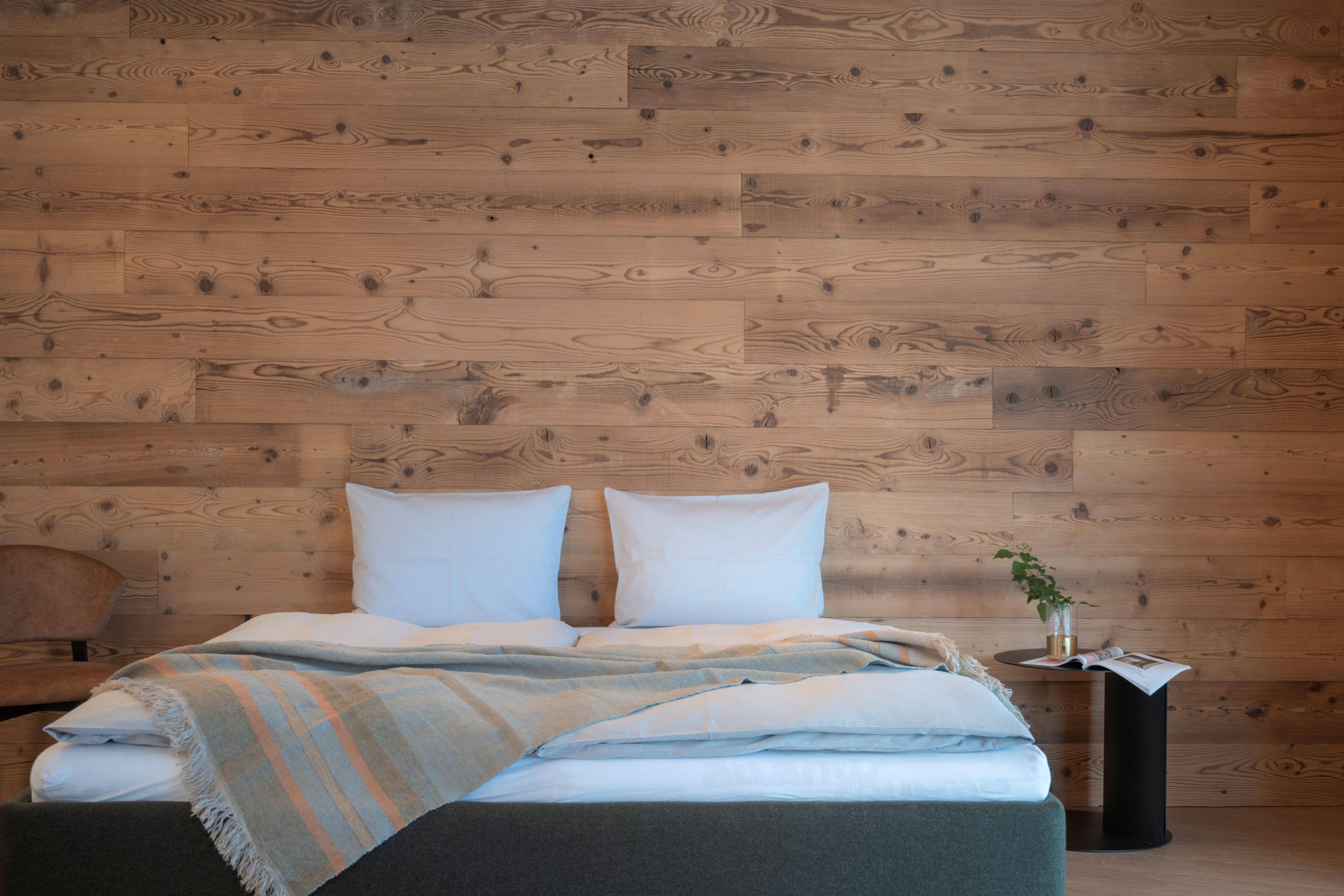
At the Buff Medical Resort, our suites and rooms allow for a medically controlled simulated high-altitude climate. While you sleep, the oxygen availability in the room can be adjusted to create conditions similar to a moderate altitude—individually customizable up to a height of 2,000 meters. This offering is currently unique worldwide. The Buff Medical Resort is the only medical resort that provides such an individually controllable high-altitude climate directly in its rooms.
What makes this special is the duration of the treatment: the hypoxic stimulus can be maintained throughout the entire night, effectively integrating it with your natural rest and recovery phase.

Medical Fundamentals
As altitude increases, air pressure drops, and with it, the partial pressure of oxygen. While the oxygen content of the air remains at around 21 percent, less oxygen is available to the body with each breath. The organism detects this change through various oxygen sensors, prompting adjustments in breathing, circulation, and cellular metabolic pathways.
When cells perceive a lower availability of oxygen, they alter their energy metabolism and the regulation of oxygen-dependent processes, among other things. This oxygen response is particularly closely linked to the mitochondria—the cell organelles where the majority of cellular ATP (adenosine triphosphate), the body's directly usable energy, is produced.
What happens in your body when you sleep in high-altitude air?
At a moderate simulated altitude, the body is not simply deprived of oxygen. Instead, it is exposed to a controlled stimulus to which the organism reacts. The intensity of this reaction depends on factors such as altitude, duration, frequency, and individual tolerance. Therefore, controlled hypoxia should not be equated with the uncontrolled drops in oxygen levels associated with sleep apnea.
The body attempts to manage the altered oxygen levels as efficiently as possible. In addition to adjustments in breathing and circulation, various signaling pathways are activated within the cells. It is precisely this cellular adaptive response that makes controlled hypoxia so compelling for modern preventive and regenerative medicine.
Mitochondria – the powerhouses of the cell
The effect of hypoxia on mitochondria is particularly interesting. They can be thought of simply as the "powerhouses" of our cells. They provide the energy our body needs for almost every function – from muscle activity and brain function to repair and growth processes. Mitochondria are not static structures. They are constantly being adapted to the needs of the cell. When the body detects a change in oxygen availability, it can trigger processes that alter how mitochondria handle oxygen and energy.
Simply put, you can think of this as an internal maintenance and renewal program: mitochondria can divide into smaller units when it makes sense for their adaptation or regulation. At the same time, damaged or underperforming mitochondria can be specifically identified and removed from the cell. Their components are broken down and reused whenever possible. In parallel, processes can be stimulated to create new mitochondrial structures.
It is therefore not just a question of how many mitochondria a cell has, but also how well these mitochondria function and how efficiently the cell can weed out damaged structures. This quality control is biologically crucial. With increasing age, high physical exertion, or various stress conditions, mitochondria can lose their efficiency. If such damaged structures are not removed sufficiently, they can impair the energy supply and the balance of the cell.
A controlled hypoxic stimulus can influence various adaptation mechanisms here. In simple terms, the cell receives a signal to reorganize its energy supply, check less efficient structures, and use existing resources more effectively.
However, it is important to note that hypoxia is not a simple "on switch" for better mitochondria. The reaction depends heavily on the intensity of the hypoxic stimulus, how long it lasts, and how frequently it is applied. Scientific literature therefore shows different effects for different forms and dosages of hypoxia.
This process can nevertheless be clearly understood as a cellular recycling and renewal program . Existing mitochondria are adapted, damaged structures can be removed, and the formation of new mitochondrial components can be supported. This very ability of the cell to respond to a targeted stimulus with adaptation and quality control is an important part of current research.
Why the night is interesting
Sleep is a key phase for regulating numerous bodily processes. Metabolism, hormonal control, immune function, and neuronal recovery all follow a complex temporal rhythm. Controlled oxygen reduction during this rest phase can provide an additional physiological stimulus without the guest having to actively exercise or wear a mask.
Using it during sleep has a unique advantage: the stimulus is not just applied for a few minutes, but can be sustained over a longer period while no active exertion takes place.
At the Buff Medical Resort, the altitude climate is individually adjusted following a medical consultation. This allows for a medically supervised application that takes your personal baseline and tolerance into account.
Altitude climate and IHT: two different applications
The Buff Medical Resort offers both passive in-room altitude climate and Intermittent Hypoxic Therapy (IHT). Both use hypoxia as a physiological stimulus, but they differ significantly in their application.
The in-room altitude climate is a passive, prolonged exposure during sleep that can be set to a simulated altitude of approximately 2,000 meters. IHT, on the other hand, is a time-limited, actively controlled application with alternating oxygen phases. A session lasts about 50 minutes and can simulate an altitude of up to 4,000 meters.
The essential difference therefore lies in the temporal structure and dosage: IHT provides a short, interval-based stimulus, while the altitude climate accompanies the guest over a longer period during the night.
Clinical relevance
The adaptation processes described are a key component of current hypoxia and mitochondrial research. Of particular interest is the interplay between oxygen sensing, energy production, and cellular quality control.
However, it cannot be automatically assumed from these biological mechanisms that every individual will achieve measurably more energy, better recovery, or improved long-term health through nocturnal altitude exposure. Clinical effects depend on the individual's baseline condition as well as the type, intensity, and duration of the hypoxia. Therefore, the application should be individually dosed and medically supervised.
In summary
High-altitude climate during sleep combines the body's natural nightly rest phase with a targeted hypoxic stimulus. At the cellular level, reduced oxygen availability can trigger signaling pathways that influence mitochondrial function and quality. Existing mitochondrial structures can be adapted and divided, damaged units removed, and the formation of new mitochondrial components regulated.
In simpler terms: the cell receives a signal to audit its energy supply, discard less efficient components, and adapt to the altered oxygen levels. However, the net effect on individual health depends on the dosage and the person's starting condition.
What makes the Buff Medical Resort unique is the integration of this controlled high-altitude climate directly into the sleeping environment. Following a medical consultation, the simulated altitude in the room can be set to approximately 2,000 meters, allowing it to take effect throughout the entire night.
FAQ
Is an indoor high-altitude climate the same as sleeping in the mountains?
No. The primary simulation is the reduced oxygen availability that occurs at higher altitudes. The actual air pressure of the location remains unchanged.
How high can the altitude climate in the room be set?
At the Buff Medical Resort, the altitude climate can be individually adjusted up to approximately 2,000 meters following a medical consultation.
What is the difference between the high-altitude climate and IHT?
The simulated high-altitude climate works passively while you sleep. It can be individually adjusted in your room up to an altitude of approximately 2,000 meters. IHT is a 50-minute interval-based session that can simulate altitudes of up to approximately 4,000 meters.
What happens to the mitochondria during hypoxia?
Controlled hypoxia can stimulate mitochondria to undergo adaptive processes. This includes the restructuring of mitochondrial components, the removal of less efficient units, and the regulation of new component formation. Simply put, this stimulus supports cellular quality control and the optimization of energy supply.
Is high-altitude climate suitable for everyone?
No. Hypoxia is a targeted physiological stimulus. Individual medical conditions, medications, and personal reactions to reduced oxygen levels must be taken into account. For this reason, sessions at the Buff Medical Resort are only conducted following a medical consultation.